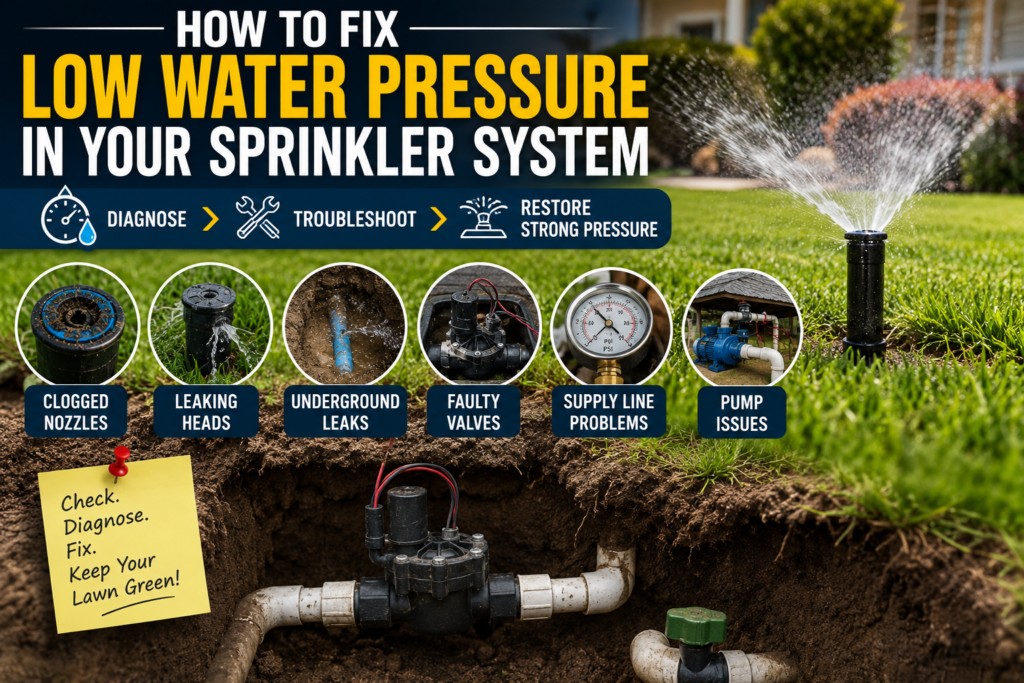
Low water pressure in sprinkler system zones can usually be traced to restricted flow, leaks, clogged nozzles, faulty valves, excessive zone demand, or a supply-side problem such as a struggling irrigation pump.
Weak sprinkler pressure almost always comes down to one of a handful of causes: restricted flow somewhere in the line, a leak that’s bleeding off pressure before it reaches the heads, a valve that isn’t opening fully, a clogged nozzle or filter, too much demand on one zone, or a supply-side problem such as a struggling irrigation pump. The right fix depends entirely on the pattern whether the weak spray is limited to one head, spread across one zone, or affecting the whole system. Chasing the wrong cause is how homeowners end up replacing parts that were never the problem.
Signs Your Sprinkler System Has Low Water Pressure
Low pressure rarely announces itself with a single obvious symptom. It usually shows up as a combination of small things that, together, mean the system isn’t delivering the flow it was designed for:
- Weak, misty, or dribbling spray instead of a firm stream or fan
- Rotor or spray heads that rise partway and stop, or never fully pop up
- Shorter throw distance, so water isn’t reaching the edges of the lawn
- Coverage that looks fine near the valve but fades out toward the end of a zone
- Patchy, uneven watering with dry or brown patches in predictable spots
- Pressure that seems to get worse as more heads activate on the same zone
None of these symptoms tell you the cause by themselves. What matters is where they’re happening, which is why the next step is more important than any single sign on this list.
First, Determine Where the Pressure Problem Is
This is the single most useful thing a homeowner can do before touching anything. Sprinkler systems are built in zones for a reason each zone has its own valve, its own pipe run, and its own set of heads, so pressure loss doesn’t affect the whole yard the same way unless the cause is upstream of every zone. Narrowing down the pattern first will save time and, often, money.
Low Pressure at One Sprinkler Head
If just one head is weak while the rest of the zone sprays normally, the problem is almost always local to that head a clogged nozzle, a cracked riser, a bad seal, or a loose connection right at that fitting.
Low Pressure in One Irrigation Zone
If every head on one zone is underperforming but other zones run fine, look at that zone specifically: its valve, its lateral line, and how much it’s being asked to do. A lateral line leak or a valve that isn’t opening all the way will drag down every head downstream of it.
Common Causes of Low Water Pressure in Sprinkler System Zones
1. Clogged Sprinkler Heads or Nozzles
Sand, mineral buildup, and debris that get pulled in from the water supply settle inside nozzles over time and restrict the opening. A partially blocked nozzle still sprays, but weakly and often in an odd pattern. This is one of the easiest problems to check and one of the most common reasons a single head underperforms.
2. Broken or Leaking Sprinkler Heads
A cracked head body, a damaged seal, or a head that’s been knocked out of alignment by a mower or foot traffic can leak water at the base instead of pushing it out through the nozzle. That lost water shows up as reduced pressure at the nozzle itself, even though the zone is receiving normal flow.
3. Underground Irrigation Pipe Leaks
A leak in a buried lateral or main line lets water escape before it reaches the heads. Because the leak point is hidden, this can look like a mysterious pressure drop with no obvious cause above ground until you notice the soil or grass reacting to it.
4. Partially Closed Irrigation or Supply Valve
If a main shutoff valve, backflow preventer isolation valve, or supply valve got bumped, adjusted, or never fully reopened after maintenance, it restricts flow into the entire system before water even reaches the first zone. This is a simple check and a surprisingly common cause of whole-system pressure loss.
5. Faulty Zone Valve or Solenoid
Each zone valve has a solenoid that opens the valve electrically when the controller calls for that zone. If the solenoid is weak, the diaphragm inside the valve is worn, or debris is caught in the valve body, the valve may open only partway enough to run the zone, but not enough to deliver full pressure. This produces the classic “one zone weak, others fine” pattern.
6. Dirty or Clogged Irrigation Filter
Systems with a main-line filter, and especially those drawing from a well or pump, can lose pressure system-wide as the filter screen fills with sediment. A filter that hasn’t been checked in a while is worth ruling out before assuming a bigger problem.
7. Too Many Sprinkler Heads Running in One Zone
Every zone is designed around a specific flow rate, measured in gallons per minute (GPM), that the pipe size and supply can actually deliver. If a zone has more heads than it was designed for because of a modification, an added head, or a design mistake the available flow gets divided among too many outlets, and every head on that zone ends up weaker than it should be. This isn’t a broken component; it’s a demand problem.
8. Water Supply or Municipal Pressure Problems
Sometimes the irrigation system isn’t the problem at all the water supply feeding the house is. A drop in municipal pressure, a neighborhood-wide supply issue, or a problem with a private well can reduce pressure to everything on the property, indoors and out. Testing an indoor faucet is a quick way to tell whether the issue is specific to irrigation or affects the whole property.
9. Pressure Regulator Problems
Some sprinkler systems, particularly those with spray heads that require a narrow pressure range, use a pressure regulator to keep output consistent. If the regulator is set incorrectly, worn out, or failing, it can either restrict flow more than intended or fail to compensate for supply fluctuations. This is worth checking specifically on systems that have one installed, rather than assumed on every system.
10. Irrigation Pump Problems
On properties that use an irrigation pump often pulling from a well or pond rather than municipal water the pump is responsible for generating the pressure and flow the entire system depends on. A pump that’s losing output over time, cycling on and off unexpectedly, running but not building pressure, or struggling to keep up with multiple zones can produce exactly the kind of whole-system pressure loss described earlier in this article. That doesn’t automatically mean the pump needs to be replaced. Pressure switches, check valves, foot valves, intake screens, and electrical components can all cause similar symptoms, which is why diagnosing the actual cause matters before assuming the pump itself has failed.
11. Incorrect Pipe Size, Excessive Friction Loss, or System Design Limitations
Water loses pressure as it travels through pipe, and that loss increases with distance, with the number of fittings and turns, and especially when pipe diameter is too small for the flow being pushed through it. This is called friction loss. On some properties particularly larger lots, systems with long lateral runs, or systems that have been added onto over the years the original pipe sizing may not be adequate for current demand. Elevation changes across a property can add to this effect as well. This is usually a background factor rather than the sole cause of a sudden pressure drop, but it’s worth understanding if a zone has always run weaker than others, even when everything checks out mechanically.
How to Fix Low Water Pressure in Sprinkler System Zones
Work through this in order rather than jumping straight to replacing parts. Each step narrows down the cause before you spend money or time on the next one.
Fixing low water pressure in sprinkler system zones starts with identifying whether the problem affects one head, one zone, or the entire system.
Step 1: Run the System Zone by Zone
Turn on each zone individually and watch how it performs on its own, not while other zones are running. Note which zones look normal and which look weak this is the pattern you’ll use for everything that follows.
Step 2: Inspect Sprinkler Heads
For any weak head, check whether the nozzle is clogged, cracked, or misaligned. Pull the nozzle if possible and look for debris. Check that the riser isn’t damaged and that the head is seated properly.
Step 3: Check for Obvious Leaks
Walk the zone while it’s running and look for water surfacing where it shouldn’t unusually wet or soggy areas, pooling, bubbling at the surface, or a section of lawn that’s noticeably greener or spongier than the rest. These are signs of a leak feeding water into the ground instead of out through the heads.
Step 4: Check Valves and Water Supply
Confirm the main shutoff valve is fully open. If the system has a backflow preventer, check that its isolation valves are open as well. Test an indoor faucet to see whether household pressure is normal, which helps separate a supply-side problem from an irrigation-specific one.
Step 5: Inspect or Clean Accessible Filters and Nozzles
If the system has an accessible main filter, check whether it’s due for cleaning. Clean any nozzle screens you can safely reach without disassembling valves or electrical components.
Step 6: Compare Individual Zones
If one zone is consistently weaker than the others even after the checks above, that points toward a zone-specific cause: a valve not opening fully, a lateral line leak, or a zone with more heads than it can support.
Step 7: Consider Pump or Supply-Side Problems
If every zone is weak and the checks above haven’t turned up an obvious cause, the issue is likely upstream either the water supply itself or, on systems that use one, the irrigation pump. Note how the system behaves: does pressure drop gradually over time, or has it always been marginal? Does the pump sound different, cycle unusually, or fail to build pressure at start-up?
Step 8: Have Persistent Pressure Loss Professionally Diagnosed
If the cause still isn’t clear, or if it involves anything below ground, inside a valve box, in the electrical wiring, or in the pump itself, this is the point to bring in a professional rather than continuing to guess. Digging into a suspected underground leak without confirming its location, opening electrical connections, or disassembling a pump can turn a straightforward repair into a bigger and more expensive one. Homeowners in Okaloosa County who reach this point can get the pressure problem properly diagnosed through professional sprinkler repair rather than replacing components based on a guess.
Why Does Only One Sprinkler Zone Have Low Pressure?
One weak zone with the rest of the system running normally almost always points to a cause specific to that zone rather than the property’s water supply. The most common reasons are a zone valve that isn’t opening fully, a leak somewhere along that zone’s lateral line, a restriction in that zone’s pipe, or the zone simply having more heads than its flow rate can support.
Because the other zones share the same main line and the same supply, ruling them out narrows the search considerably. Start by checking whether the zone valve is opening completely a partially stuck valve is common and easy to miss without watching the valve itself operate. From there, walk the zone’s pipe run looking for wet ground, and count how many heads are active on that zone compared to similar zones in the system. If a zone was modified or extended after installation, it may simply be asking for more flow than the pipe size or valve was designed to deliver.
Why Do My Sprinkler Heads Not Pop Up All the Way?
A head that doesn’t fully rise is usually being starved of the pressure or flow it needs to extend completely, most often from a clogged nozzle or filter, a leak upstream in the line, a valve not opening all the way, or too many heads competing for water on the same zone.
Rotor and spray heads rely on water pressure pushing against an internal spring or piston to rise out of the ground. When pressure at that head is reduced for any of the reasons already covered in this article the head may extend partway, wobble, or sink back down instead of locking into its full upright position. If only one head does this, check that head directly. If several heads on the same zone all behave this way, the cause is more likely upstream, in the valve or the line feeding that zone.
Can a Leak Cause Low Sprinkler Pressure?
Yes. A leak anywhere in the irrigation system at a fitting, along a lateral line, in the main line, or at a damaged head reduces the amount of water and pressure available to reach the heads downstream of it, because water is escaping before it gets there.
Leaks aren’t always visible at the surface right away, but there are usually clues: a patch of lawn that’s unusually wet, spongy, or green compared to the surrounding area even on days the system isn’t running; pooling water near a valve box; small sinkholes or soft spots forming along a pipe run; or an unexplained increase in water usage. A leak close to the valve affects the entire zone, while a leak near the end of a line mainly affects the heads past that point. Underground leaks in particular are difficult to pinpoint without experience and equipment, which is one of the more common reasons homeowners bring in irrigation system repair rather than digging blind.
Can a Bad Irrigation Pump Cause Low Water Pressure?
Yes, on systems that rely on a pump typically those drawing from a well or pond rather than municipal water. If the pump can no longer generate or maintain adequate pressure and flow, every zone downstream of it can be affected, which often shows up as weak pressure system-wide rather than in just one area.
That said, pump-related symptoms can also come from a failing pressure switch, a bad check valve, a clogged intake screen, or electrical issues rather than the pump itself needing to be replaced. Because pump troubleshooting often involves electrical components and wiring, it isn’t something to take apart without the right experience an incorrect diagnosis can lead to replacing a pump that wasn’t actually the problem, or missing a simpler fix. Proper diagnosis first is what determines whether the pump needs attention at all, and it’s why pump evaluation is treated as its own step rather than a default assumption. Summit Outdoors’ irrigation pump service covers this kind of diagnosis, along with replacement when a pump has genuinely reached the end of its service life.
How Much Water Pressure Does a Sprinkler System Need?
There’s no single PSI number that applies to every sprinkler system, and treating one as a universal target can cause more problems than it solves. The pressure a system needs depends on the type of sprinkler heads installed, the manufacturer’s specifications for those heads, how the zones were designed, the pipe size feeding them, elevation changes across the property, and how much flow is available to begin with.
As a general point of reference rather than a rule, University of Florida IFAS Extension guidance on residential irrigation notes that household water pressure is ideally about 40 to 60 psi, though this varies significantly by location, and that many spray-type sprinklers are designed to perform best in a narrower range around that pressure that’s too low causes poor coverage, while pressure that’s too high can break the spray pattern into fine mist and reduce efficiency. Separately, UF/IFAS guidance for home turf irrigation suggests that when manufacturer specs for a specific sprinkler aren’t available, operating at roughly 25 to 30 psi is a reasonable general starting point for measuring spray diameter and spacing. These are useful benchmarks, not requirements the correct operating pressure for any individual system ultimately comes down to what the installed heads were designed for.
If a system is consistently running well outside a reasonable range for its sprinkler type, that’s a sign something upstream a valve, a leak, a pump, or the supply itself needs attention, rather than something to correct by adjusting one head at a time.
Low Sprinkler Pressure in Okaloosa County, FL
Sprinkler systems across Okaloosa County run into pressure problems for the same underlying reasons systems anywhere do clogs, leaks, valve wear, and pump performance but local conditions can shape how those problems show up. Sandy soil, common throughout the area from Fort Walton Beach to Niceville, drains quickly and doesn’t hold visible surface water the way denser soil does, which means an underground leak can go unnoticed longer than it would elsewhere; the ground simply absorbs the water instead of pooling it. Properties near Destin and Shalimar that rely on well-fed irrigation systems also depend more directly on pump performance, since there’s no municipal supply to fall back on if output drops.
None of this changes the diagnostic approach outlined above identifying whether the pressure loss is at one head, one zone, or the whole system is still the starting point regardless of location. It just means that when the cause isn’t obvious from a visual inspection, getting an accurate diagnosis matters more in this area than in places where a leak would announce itself with standing water.
When Should You Call a Sprinkler Repair Professional?
When low water pressure in sprinkler system operation persists after basic troubleshooting, the cause may require professional diagnosis.
Basic checks inspecting heads, looking for surface leaks, confirming valves are open, and comparing zones are safe for most homeowners to do themselves. Professional diagnosis becomes the better option once the cause isn’t obvious, or once fixing it means going somewhere a wrong move gets expensive:
- Multiple zones lose pressure at the same time, or the whole system suddenly weakens
- Pressure stays low after the basic checks above turn up nothing
- You suspect an underground leak but can’t locate it
- A zone valve seems to be the problem but isn’t opening or closing properly
- The irrigation pump can’t maintain pressure or is cycling oddly
- The issue involves the controller, wiring, or other electrical components
- You’ve worked through the diagnostic steps and still can’t isolate the cause
At that point, a proper inspection can determine whether the problem is a leak, a valve, a restriction, a sprinkler head, the water supply, or the pump before any parts get replaced on a guess. If basic troubleshooting doesn’t restore normal pressure, sprinkler system repair in Okaloosa County from Summit Outdoors covers exactly this kind of diagnosis, drawing on more than 30 years in the irrigation industry, for homeowners throughout Fort Walton Beach, Niceville, Destin, Shalimar, and the surrounding area. For a broader look at other sprinkler issues beyond pressure, the site’s sprinkler troubleshooting guide covers additional symptoms and causes.
If basic troubleshooting doesn’t bring your pressure back to normal, Summit Outdoors diagnoses sprinkler pressure problems throughout Okaloosa County, including Fort Walton Beach, Niceville, Destin, Shalimar, and the surrounding communities. An accurate diagnosis determines whether the cause is a leak, a valve, a restriction, a sprinkler head, a supply issue, or the irrigation pump before any parts get replaced unnecessarily. Get in touch with Summit Outdoors to have your system properly diagnosed.
Frequently Asked Questions
How do I increase water pressure in my sprinkler system? Start by identifying whether the weak pressure affects one head, one zone, or the whole system, since the fix depends on the cause. Clearing clogged nozzles or filters, repairing leaks, making sure valves are fully open, and reducing the number of heads running on an overloaded zone are the most common fixes. If pressure stays low after those checks, the cause is likely upstream the supply itself or, on well-fed systems, the pump.
Why does only one sprinkler zone have low pressure? It’s usually a cause specific to that zone: a valve not opening fully, a leak along that zone’s lateral line, a restriction in its pipe, or too many heads for the flow that zone was designed to handle. Other zones running normally rules out the main water supply as the cause.
Why are my sprinkler heads barely spraying? Weak spray at one or more heads typically comes from a clogged nozzle, a cracked or damaged head, insufficient pressure reaching that head, or a zone that’s overloaded with too many active heads at once.
Can clogged sprinkler heads reduce water pressure? Yes. Sediment and debris that build up inside a nozzle restrict how much water can pass through it, which reduces both the flow and the pressure at that head, even when the rest of the zone is delivering normal pressure.
Can an underground irrigation leak cause low pressure? Yes. Any leak lets water escape before it reaches the sprinkler heads, which lowers the pressure and flow available downstream of the leak. In sandy soil, underground leaks can be hard to spot visually since water drains away instead of pooling.
How do I know if my sprinkler pump is going bad? Watch for pressure that drops gradually over time, a pump that cycles on and off unexpectedly, unusual noise, or a system that can’t maintain pressure once more than one zone or several heads are running. These symptoms can also come from a pressure switch, check valve, or electrical issue, so proper diagnosis is worth doing before assuming the pump itself has failed.
Can too many sprinkler heads cause low pressure? Yes. Every zone is designed around a specific flow rate. Adding heads beyond what that zone’s pipe size and valve were designed to support divides the available water among more outlets, which weakens pressure at every head on that zone.
Should I install a booster pump for my sprinkler system? That depends on why pressure is low in the first place. A booster pump can help in specific supply-limited situations, but it isn’t a universal fix, and adding one without first diagnosing the actual cause of low pressure can mean paying for equipment that doesn’t solve the real problem. This is a decision worth making after a proper diagnosis rather than before one.