If your sprinklers suddenly seem weaker, one or two zones barely trickle, or the pump won’t even kick on, it’s natural to wonder whether you’re looking at a quick fix or the end of the road for your irrigation pump. The good news is that most of the warning signs are easy to recognize once you know what to look for and a few simple checks can tell you a lot before you ever pick up the phone.
This guide walks through the clearest signs your irrigation pump needs replacing, the safe DIY checks you can do yourself, and how to decide whether repair or replacement makes more sense for your system.
An irrigation pump’s job is simple in concept: it moves water from your source (a well, pond, or municipal line) and adds enough pressure to push that water evenly through every zone of your sprinkler system. According to the University of Florida IFAS Extension, most residential and agricultural irrigation pumps in Florida are centrifugal pumps, which use a rotating impeller inside a sealed casing to add pressure and velocity to the water as it moves through the system.
How an Irrigation Pump Works (Quick Overview)
That impeller, along with the motor, seals, bearings, and pressure switch, all wear down over time especially with the long watering seasons and heavy summer use typical of Northwest Florida. When one of these components starts to fail, you’ll usually notice it through one of the symptoms below before the pump fails completely.
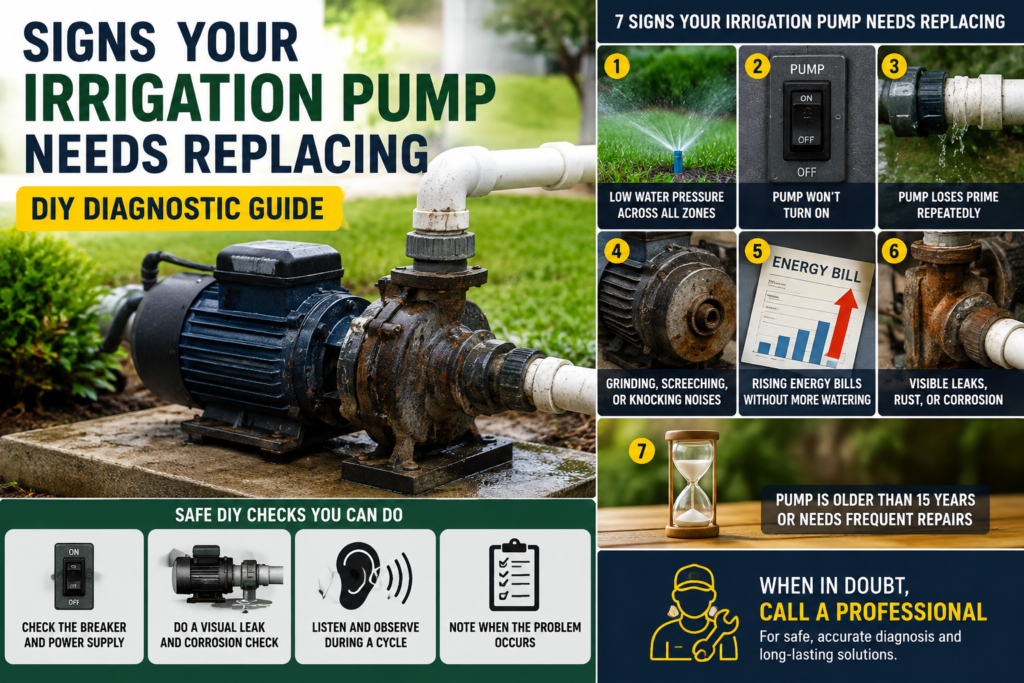
7 Signs Your Irrigation Pump Needs Replacing
1. Noticeably Lower Water Pressure Across All Zones
A little pressure loss in a single zone is often a clogged nozzle or a broken head, not the pump. But if every zone is weaker than it used to be heads barely popping up, misting instead of spraying, or dry patches spreading across the whole yard the pump itself may not be generating enough pressure anymore. If you’re only seeing pressure problems in one or two zones, it’s worth ruling out other causes first; we cover those in our guide onother causes of low irrigation pressure before assuming the pump is at fault.
2. The Pump Won’t Turn On At All
Before assuming the worst, check the breaker a tripped breaker is a common, harmless cause. But if the breaker is fine, power is reaching the pump, and it still won’t start, you’re likely dealing with a failed motor, a bad capacitor, or a pressure switch that’s no longer signaling the pump to run. Repeated “no start” issues, even after resets, are one of the strongest indicators that the pump itself has failed.
3. The Pump Loses Prime Repeatedly
If your pump runs fine one cycle and then struggles to build pressure the next, it may be losing prime meaning air is getting into the pump casing or suction line instead of water. Occasional priming issues can sometimes be traced to a loose fitting, but a pump that loses prime over and over, even after fittings are tightened, usually points to worn seals or a failing foot valve inside the pump itself.
4. Grinding, Screeching, or Knocking Noises
A healthy irrigation pump runs with a steady, relatively quiet hum. Grinding, screeching, rattling, or knocking sounds usually mean something mechanical is wearing out a failing bearing, a damaged impeller, or a motor under strain. These noises rarely go away on their own, and running the pump longer with worn internal parts can turn a moderate repair into a full replacement.
5. Rising Energy Bills Without More Watering
If your irrigation schedule hasn’t changed but your energy bill has climbed, a struggling pump motor may be drawing more power to produce the same (or less) output. This is easy to overlook because it happens gradually, but it’s a real cost that adds up over a full Florida watering season.
6. Visible Leaks, Rust, or Corrosion Around the Pump
Standing water, rust stains, or corrosion around the pump housing are signs the casing, seals, or fittings are breaking down. This is especially relevant near the coast homes in areas like Fort Walton Beach and Destin deal with salt-laden air that accelerates corrosion on metal pump components faster than it would inland. Visible corrosion is rarely a “wait and see” situation.
7. The Pump Is Older Than 15 Years or Needs Frequent Repairs
Most residential irrigation pumps have a reasonable service life, but repeated repairs on an older unit start to add up both in cost and in downtime for your lawn. If you’re calling for the same type of repair every year, or the pump has been in service well over a decade, replacement is usually the more cost-effective long-term choice.
Safe DIY Checks You Can Do Before Calling a Professional
Before you assume the worst, there are a few checks any homeowner can safely do:
- Check the breaker and power supply. Confirm the breaker hasn’t tripped and that power is actually reaching the pump before troubleshooting further.
- Do a visual leak and corrosion check. Look around the base of the pump for pooling water, rust, or visibly corroded fittings.
- Listen and observe during a cycle. Run one zone and listen for unusual noise, and watch whether pressure builds normally or fluctuates.
What you should not do yourself: open the pump housing, work on wiring, or attempt to replace internal components like the impeller or pressure switch. Irrigation pump wiring and internal repairs involve real electrical and water-pressure risk, and improper repairs can void a warranty or cause further damage. If your DIY checks point to a deeper issue, that’s the point to bring in a professional for an accurate diagnosis oursprinkler and irrigation repair services cover exactly this kind of diagnostic work.
Repair vs. Replace: How to Decide
Not every pump problem means you need a whole new pump. A single failed capacitor, a stuck pressure switch, or a loose fitting can often be repaired affordably. Replacement generally makes more sense when:
- The pump is older than 10–15 years
- You’ve had more than one repair in the past year or two
- The motor or impeller itself has failed (rather than a smaller external part)
- Repair costs are approaching a significant portion of what a new pump would cost
A repaired pump also typically can’t be warrantied the same way a new installation can, which is worth factoring into the decision if you want long-term reliability rather than repeat service calls.
Why Ignoring a Failing Pump Costs You More
A struggling pump doesn’t just mean weaker sprinklers it often means wasted water. TheEPA’s WaterSense program notes that even a small irrigation leak, about the diameter of a dime, can waste thousands of gallons of water a month. A failing pump that’s overworking itself, losing prime, or pushing water through worn seals compounds that waste, showing up as higher water bills, stressed or dying turf, and in Florida’s heat a lawn that struggles to recover once the pump finally fails completely.
What Professional Pump Replacement Involves in Okaloosa County
If a professional diagnosis confirms replacement is the right call, the process is more involved than simply swapping in a new pump. A proper installation includes correctly sizing the pump for your property and zone count, wiring and pressure-testing it before the job is complete, and confirming it’s compliant with local code. Our irrigation pump installation and replacement service covers everything from shallow well pumps for residential lawns to higher-capacity booster pumps for larger properties, for homeowners throughout Fort Walton Beach, Niceville, Destin, Shalimar, and surrounding Okaloosa County communities.
Preventing Future Pump Problems in Florida’s Climate
A few habits go a long way toward extending the life of your next pump:
- Have your system inspected each spring, similar to the seasonal “sprinkler spruce-up” the EPA WaterSense program recommends, to catch small issues before they strain the pump.
- Keep the pump area clear of debris and standing water, especially after storms.
- Watch for early warning signs noise, pressure changes, or rising bills rather than waiting for a full failure.
- Consider pump placement and protection if you’re near the coast, where salt air accelerates corrosion.
FAQ
How long do irrigation pumps typically last? Most residential irrigation pumps last somewhere between 10 and 15 years with regular use, though this varies based on pump quality, water source, and local conditions like coastal salt air or heavy sand content.
Can I repair an irrigation pump myself? Basic checks like confirming power and checking for visible leaks are safe to do yourself. Internal repairs, wiring, and pressure switch work involve electrical risk and are best left to a licensed technician.
Why does my irrigation pump keep losing prime? Repeated priming issues are usually caused by a small air leak in the suction line, a loose fitting, or worn internal seals. If tightening connections doesn’t solve it, the pump likely needs professional inspection.
Is it cheaper to repair or replace an irrigation pump? It depends on the pump’s age and the type of failure. A single component failure on a newer pump is often worth repairing; an older pump with repeated issues is usually more cost-effective to replace.
Why won’t my irrigation pump turn on? Start by checking the breaker. If power is reaching the pump and it still won’t start, the motor, capacitor, or pressure switch may have failed.
What causes an irrigation pump to lose water pressure? Pressure loss can come from a worn impeller, a failing motor, clogged intake screens, or issues elsewhere in the system like a broken head or leaking valve which is why a proper diagnosis matters before assuming it’s the pump.
How much does irrigation pump replacement cost? Costs vary based on pump type, sizing, and property needs. A professional evaluation is the most accurate way to get pricing specific to your system.
Ready for a Straight Answer on Your Pump?
If you’re seeing any of these signs, don’t wait for a full breakdown to find out. Summit Outdoors provides honest, diagnosis-first irrigation and pump repair services throughout Okaloosa County including Fort Walton Beach, Niceville, Destin, and Shalimar. We’ll tell you plainly whether your pump needs a repair or a replacement, with no unnecessary upselling Contact us.