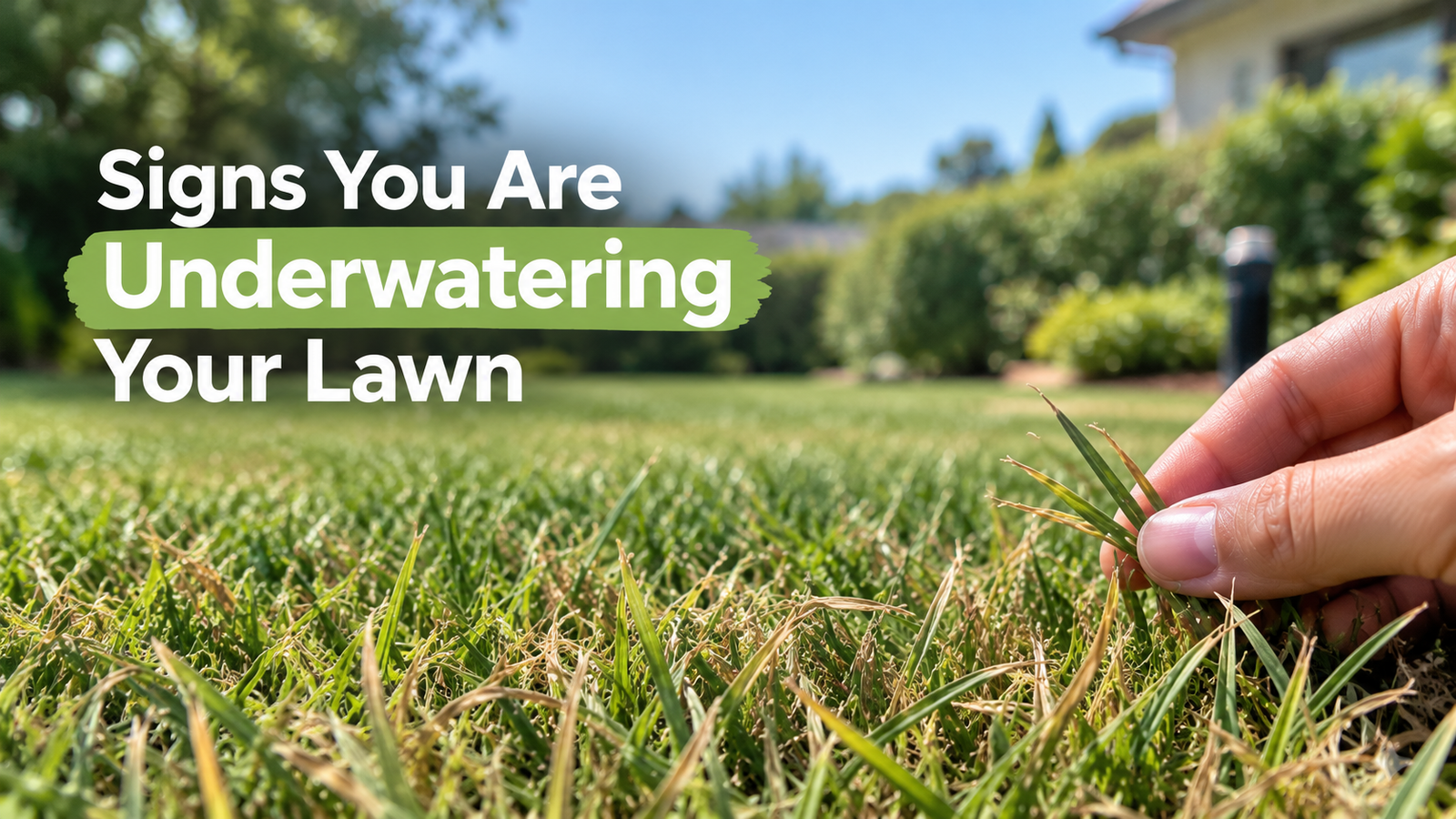
Brown patches curling blades and grass that looks tired by mid-afternoon are all easy to blame on thirst. Sometimes that is exactly the cause. Other times the real culprit is a sprinkler head that is clogged a zone that never turns on or a disease that only looks like drought.
The short answer: the clearest signs of an underwatered lawn are blades that fold or curl a dull blue-gray tint and footprints that stay visible long after you walk across the grass. If you see those signs across a meaningful part of the lawn and the soil a few inches down is dry your grass likely needs water. This guide explains what each symptom means how to confirm the cause and how to fix it without swinging into overwatering.
9 Signs You Are Underwatering Your Lawn
No single symptom proves the cause. The more of these you see together and the more they line up with dry soil the more confident you can be.
1. Grass blades wilt curl or fold
What you see: Blades fold in half lengthwise like a closing book or roll inward and look limp.
Why it happens: Grass loses internal water pressure when it cannot pull enough moisture from the soil. Folding reduces the surface area exposed to sun and slows water loss.
How to check: Look in the evening or early morning. Midday heat can make healthy grass fold temporarily so a lawn that is still folded after it cools down is a stronger signal. According to UF/IFAS Extension guidance for Okaloosa County the evening is the best time to look for these signs and it is time to water when about one-third of the lawn shows them.
Other causes: Root damage from grubs nematodes or disease can cause wilting even when soil is moist.
Next step: Probe the soil (see the confirmation section below) before turning on the sprinklers.
2. Grass turns dull blue-gray or bluish-green
What you see: The lawn loses its healthy sheen and takes on a grayish or bluish cast often in patches first.
Why it happens: Stressed blades reflect light differently as they lose turgor. UF/IFAS lists a blue-gray tint as one of the key signs of turf wilt.
How to check: Compare the dull areas with a spot that gets reliable water. If the difference is obvious and the dull area is also dry underneath water stress is likely.
Other causes: Nutrient problems and some fungal issues can dull color but they usually do not come with dry soil.
Next step: Note which areas are affected so you can compare them with your sprinkler coverage later.
3. Footprints stay visible
What you see: You walk across the lawn and your footprints or mower tracks remain flattened.
Why it happens: Turgid grass springs back. Dehydrated blades lack the internal pressure to rebound. UF/IFAS describes lingering footprints as one of the three classic signs that a lawn needs irrigation.
How to check: Walk a straight line across a sunny section and look back after 30 minutes or so. Healthy grass should have recovered.
Other causes: Very thin turf or soil compaction can leave marks though the grass usually still looks green and fully hydrated.
Next step: If footprints linger along with folding or graying blades plan to water soon.
4. Grass turns brown or develops dry patches
What you see: Straw-colored areas that spread often starting along driveways sidewalks slopes or sunny edges.
Why it happens: When water stress continues, leaf tissue dies back. Hot pavement and sunny exposures dry out first.
How to check: Tug a handful of brown blades. If the crown and roots are still firm and the grass pulls up with resistance it may be dormant rather than dead. Brown patches in a lawn with otherwise healthy moist soil deserve a closer look for pests or disease.
Other causes: Brown patch fungus chinch bugs dog urine fertilizer burn and herbicide damage all cause brown areas. Do not assume dryness without confirming it.
Next step: Probe the soil under the brown area and under healthy grass next to it then compare.
5. Growth slows and the lawn looks thin
What you see: The grass barely grows between mowings and the lawn looks sparse.
Why it happens: Grass cannot photosynthesize and grow efficiently without enough water. Slow growth is partly a natural drought response.
How to check: If you are mowing much less often than usual during the growing season and see other symptoms water stress is a candidate.
Other causes: Cooler fall temperatures also slow growth as do shade low fertility and compaction.
Next step: Look for the other signs on this list before changing your schedule.
6. Soil becomes dry and hard in the root zone
What you see: The ground feels hard may crack and resists a screwdriver or soil probe.
Why it happens: Dry soil firms up and loses the pore space that lets roots and water move through it. In sandy soil which holds less water the lawn can dry quickly between rainfalls or irrigation cycles.
How to check: Push a screwdriver or soil probe into the ground a few inches. If it slides in easily the soil has moisture. If you have to force it or the soil comes up dry and crumbly the root zone is dry.
Other causes: Compaction from foot traffic or construction can also make soil hard even when moisture is present.
Next step: If the soil is dry at root depth water deeply then recheck.
7. Grass blades are brittle or crispy
What you see: Blades crunch underfoot and snap rather than bend.
Why it happens: Prolonged water stress dries the leaf tissue itself.
How to check: Rub a blade between your fingers. Crispy and papery suggests advanced stress.
Other causes: Heat scorch chemical burn and sun exposure on a freshly cut lawn can cause crispiness.
Next step: Water gradually and monitor recovery. Crisp blades will not turn green again but new growth can.
8. Different areas show uneven stress
What you see: One zone is brown while another stays green. Dry stripes or circles appear in a pattern.
Why it happens: Uneven stress usually points to uneven water delivery not a lawn-wide scheduling problem. A single clogged nozzle or tilted head can leave a section dry.
How to check: Run a catch-can test (described below). UF/IFAS recommends placing shallow cans in both the good and bad areas to see how evenly the system distributes water.
Other causes: Slopes shade soil type changes and compaction also create patchwork stress.
Next step: Walk the zone while it runs and look for heads that are blocked buried or spraying the wrong direction.
9. The lawn struggles to recover in hot or dry weather
What you see: The grass looks decent after watering then fades again within a day or two.
Why it happens: Shallow infrequent moisture fast-draining sandy soil or inadequate run times may not be reaching deep enough to support roots.
How to check: Probe the soil a day after watering. If it is already dry a few inches down water is not soaking in deep enough or fast enough.
Other causes: Heavy thatch compacted soil and sprinkler heads that produce too little output all reduce effectiveness.
Next step: Calibrate your system with a catch-can test so you know how much water each zone actually delivers.
How to Confirm That Your Lawn Is Underwatered
A lawn that looks dry is a clue not a diagnosis. Use these checks to narrow it down.
- Probe the soil. Use a screwdriver trowel or soil probe a few inches down. Moist soil is easy to penetrate; dry soil is hard and crumbly.
- Watch for recovery. Check blades in the evening. If grass that was folded in the afternoon is flat and green after sunset it may have been heat stress rather than drought.
- Compare dry and healthy spots. Probe both. If the dry patch is dry underneath and the healthy area is moist, you likely have a water delivery problem.
- Run a catch-can test. Set out five to ten straight-sided cans (tuna cans work well) run one zone for 15 minutes, and measure the depth in each can. Large differences between cans mean uneven coverage.
- Watch each zone run. Look for heads that do not pop up spray weakly or throw water onto pavement.
If the soil is moist and the grass is still brown stop and consider disease insects or fertilizer or herbicide damage. A university extension office can help identify the cause.
Why Florida Lawns May Not Receive Enough Water
Several factors can leave grass short on water and they vary by property:
- Heat and evaporation. Hot sunny windy days pull moisture out of the soil quickly.
- Sandy soil. Many Florida soils drain fast and hold less water. UF/IFAS notes that sandy soils may need the higher end of the recommended application rate while heavier clay soils in North Florida and the Panhandle may need only the lower end.
- Inconsistent schedules. Skipped cycles a controller that lost power or a schedule that never got adjusted for the season.
- Sprinkler problems. Clogged sunken damaged or misdirected heads reduce coverage.
- Pressure and distribution issues. Low pressure or mixed head types in one zone can create dry spots.
- Zone failures. A zone that never turns on leaves its entire section dry.
- Restrictions and seasonal changes. Local rules may limit days or hours and water needs shift through the year.
- Site conditions. Slopes shed water, compacted soil resists it and sunny or paved edges dry out faster than shaded areas.
Water-restriction rules differ by water management district and sometimes by city or utility. Okaloosa County falls within the Northwest Florida Water Management District, which issued a voluntary Water Shortage Warning in February 2026 and reported in May that the order remained in effect. Check with the district and your water utility for current requirements before you adjust your schedule.
How Much Water Does Your Lawn Need?
There is no single schedule that fits every Florida lawn. Needs depend on grass species soil type, rainfall, temperature sunlight rooting depth and local rules. Our guide on how much water your lawn needs goes deeper but the core idea is to measure what your system delivers rather than guess.
What UF/IFAS recommends: For most Florida lawns apply about one-half to three-quarters of an inch of water when the grass shows signs it needs water rather than watering on a fixed calendar.
How to measure your output:
- Place straight-sided containers across one zone.
- Run the zone for 15 minutes.
- Measure the depth in each can and average the results.
- Multiply that average by four to estimate inches per hour.
For example UF/IFAS Okaloosa County explains that if the cans collect an average of one-quarter inch in 15 minutes the zone needs 30 minutes to deliver half an inch or 45 minutes for three-quarters of an inch.
Gallons per square foot: One inch of water over one square foot works out to about 0.623 gallons. A 1000-square-foot lawn therefore needs roughly 623 gallons per inch applied.
Rainfall counts. If recent rain delivered a good soaking the lawn may not need irrigation. A rain gauge makes this easier to judge.
For schedule examples tailored to the state, see our effective lawn watering schedule for Florida homes and confirm the current UF/IFAS guidance and any local restrictions before locking in a schedule.
How to Fix an Underwatered Lawn
- Confirm the cause. Probe the soil and look for the signs above. Do not water just because the lawn looks off.
- Check coverage. Run a catch-can test and watch each zone operate.
- Adjust to your conditions. Consider grass type, soil, and local rules.
- Water deeply, without runoff. UF/IFAS advises never irrigating to the point of runoff.
- Split cycles if needed. If water runs off a slope or compacted soil before it soaks in, break the run time into two shorter cycles with a pause between them.
- Repair problem heads. Clean clogged nozzles, straighten tilted heads, and raise sunken ones where safe to do so.
- Monitor the response. Check the lawn over the next several days for improved color and recovery.
- Avoid swinging too far. Stressed grass does not need constant watering. Wait for the lawn to show signs of thirst again before the next cycle.
Be realistic about outcomes. Lightly stressed grass often rebounds quickly. Severely damaged or dormant grass can take time and some brown patches will not return. UF/IFAS notes that bahiagrass and centipedegrass may turn brown in drought but are more likely to resume growth once water returns.
Timing matters too. UF/IFAS recommends irrigating in the early morning preferably between 4 a.m. and 8 a.m. and avoiding the middle of the day when much of the water evaporates. Our guide to the best time of day to water your lawn covers the reasoning.
Underwatering vs. Overwatering: How to Tell the Difference
Both problems can leave grass yellow, thin, or brown, which is why guessing often makes things worse. UF/IFAS even points out that most turf damage in Florida is actually caused by overwatering.
| Clue | More likely underwatering | More likely overwatering |
| Soil | Dry and hard a few inches down | Soggy squishy or persistently wet |
| Footprints | Linger | Spring back but ground feels spongy |
| Blades | Folded blue-gray crispy | Yellowing soft sometimes with fungus or mushrooms |
| Pattern | Dry zones edges slopes | Low spots areas with the most spray |
| Extras | Dry cracks slow growth | Runoff puddles weeds thatch |
Complications exist. Wilting can occur in wet soil if roots are damaged and fungal disease can create brown patches in a lawn that is getting plenty of water. Poor drainage can also leave one area soggy while another dries out.
Before changing your schedule compare your lawn against the signs of an overwatered lawn. If the soil is wet and the grass looks stressed adding water will not help.
When Your Sprinkler System May Be the Problem
A controller can run on schedule while parts of the lawn get little or nothing. Common causes include:
- A zone that does not activate. The whole section stays dry. See why a sprinkler zone may not turn on.
- Heads that do not pop up. Debris damage or low pressure can keep them down. Here is how to troubleshoot sprinkler heads that are not popping up.
- Low water pressure. Weak spray short throw or misting can leave gaps. Learn more about low water pressure in a sprinkler system.
- Uneven coverage. Misaligned heads mixed nozzle types or blocked spray patterns.
- Pump problems. For systems that use a pump a failing pump can reduce pressure and flow across multiple zones.
Safe checks you can do yourself:
- Run each zone manually from the controller and watch it operate.
- Look for heads that are clogged, tilted, buried in grass, or damaged.
- Clear grass and debris from around heads.
- Note any zone that does not start produces weak spray or leaves wet spots next to dry ones.
Stop there. Do not open electrical panels work on wiring or attempt repairs on a pressurized pump or main line. Those jobs are best left to a qualified irrigation professional.
How to Prevent Underwatering in the Future
- Build a weather-aware routine. Adjust for rainfall and for seasonal changes. Fall’s shorter days and cooler temperatures slow turf growth, which usually means less irrigation than summer.
- Inspect regularly. A quick walk-through of each zone every month catches clogged and misdirected heads before they cause damage. Our beginner guide to irrigation maintenance outlines what to look for.
- Repeat the catch-can test. Do it at least once a year and after any system repair.
- Track rainfall. A simple rain gauge shows whether natural rain already met the lawn’s needs.
- Water at efficient times. Early morning reduces evaporation and gives blades time to dry.
- Fix small issues early. One dry corner today can become a lawn-wide problem during the next heat wave.
Frequently Asked Questions
What are the first signs of an underwatered lawn?
Folded or curled blades a blue-gray tint and footprints that do not spring back are typically the earliest visible signs usually before the grass turns brown.
How can I tell whether my grass needs water?
Look for the signs above then probe the soil a few inches down. If both point to dryness water. UF/IFAS suggests watering when roughly one-third of the lawn shows signs of stress.
Can brown grass turn green again after watering?
Sometimes. Dormant grass with living crowns and roots can recover while dead grass cannot. Recovery depends on grass type how long it was dry and whether something else, such as pests or disease was involved.
How often should I water my lawn in Florida?
There is no single answer. UF/IFAS recommends watering when the lawn shows signs of need and applying about one-half to three-quarters of an inch each time. Local restrictions, grass type soil and rainfall all matter so check current rules and measure your system’s output.
Is it better to water a lawn every day or less frequently?
For most lawns deeper less frequent watering supports healthier roots than frequent shallow watering. UF/IFAS also cautions that watering on a rigid schedule can lead to overwatering.
Why is my lawn brown even when my sprinklers are running?
Possible causes include a clogged or misdirected head a zone that is not delivering enough water low pressure short run times or a non-water problem like disease or insects. A catch-can test and a soil probe are good places to start.
Can faulty sprinkler heads cause dry patches?
Yes. Clogged nozzles tilted or sunken heads and damaged spray patterns can leave sections of lawn undersupplied while the rest looks fine.
What is the best time of day to water a lawn?
UF/IFAS recommends early morning ideally between 4 a.m. and 8 a.m. and advises against irrigating between 10 a.m. and 4 p.m. when water is more likely to evaporate before it soaks in.
Final Thoughts
Start with the lawn’s own signals: folded blades a gray-blue tint and lingering footprints. Confirm them with a soil probe and a catch-can test then decide whether the fix is a schedule adjustment or a repair. Watering habits and sprinkler performance work together so a perfect schedule cannot overcome a zone that does not run and a perfect system cannot help if it applies the wrong amount of water.
If you have checked the basics and still have dry patches uneven coverage or zones that will not cooperate Summit Outdoor Irrigation can help. Learn more about our sprinkler system repair services or contact our team to talk through what you are seeing.